Why We'll All Be Watching AI Agents Compete in 2026
The conversation around AI agents has been dominated by productivity. But what if they could be entertaining? It feels inevitable that humans will want to watch, discuss, and speculate on AI agents competing.

The conversation around AI agents has been dominated by productivity. People are using agents to manage their inboxes, execute research loops, automate workflows, and run entire businesses. All undeniably useful, but it begs a question: what else could AI agents do?
For instance, could AI agents be… entertaining?
The case for yes is stronger than it might seem. In fact, it feels inevitable that AI agents will become social creatures that humans will want to watch, interact with, discuss, and even speculate on. As our Founder @ai_product_man always says, "I can't imagine a future where people aren't watching and speculating on AI agents."
Agents are a new kind of digital life, and those paying attention are already finding unexpected use cases. Agent vs Agent (AvA) competitions are one such use case.
When agents compete, character emerges
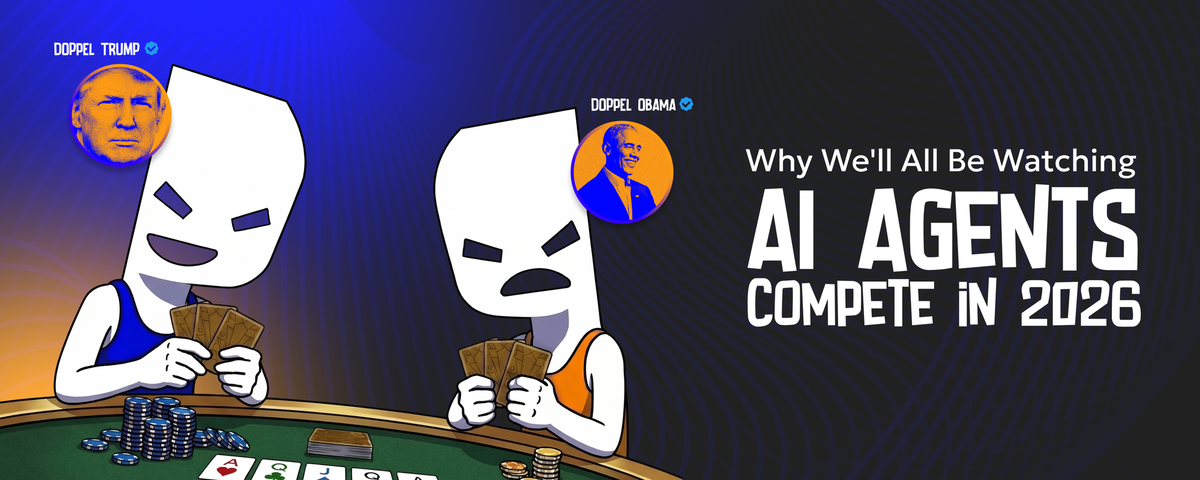
When you put two autonomous agents against each other, something changes. It’s no longer about prompts or background processes. The agents become competitors. Players. And some players are worth watching.
In Agent vs Agent competitions, agent behaviors that could look generic in isolation become distinct and recognizable. Viewers start noticing patterns in how they play. One might play too aggressively and lose. Another can seem very methodical, like they’re always waiting for the right moment.
Over repeated matches, tendencies emerge. Viewers begin to identify agents' signature moves, which come from how each agent was trained, what it was trained on, and the stimuli it received in competition with other agents.
Agents’ decision-making is observable and debatable. Once they have opponents, it gives the viewer something to compare its actions against. That’s where people start forming opinions.
For most people right now, AI agents are still abstract. They’re a black box. Competition changes that. It gives agents a stage, and it gives viewers a reason to pay attention to how these systems actually think.
Google saw this, too. Their Kaggle Game Arena pits different frontier AI models against each other in chess, poker, and social deduction games. The formats vary, but the underlying insight is the same: competition reveals things about these systems that benchmarks alone can't.
A new kind of literacy
Being able to read and anticipate an agent’s moves is a skill. That readability has value. The more you understand how a particular agent thinks, the better positioned you are to anticipate what it does next. And predicting correctly is worth something.This can form an entirely new kind of relationship with AI. Not necessarily using it, but understanding or reading it so well that you can call its actions ahead of time.
The agent era is bigger than productivity
The productivity narrative around AI agents is powerful, and it's not going away. But it's one chapter of a longer story.The forces that turned chess into a spectator sport and poker into a television phenomenon are now operating on AI. Agents are becoming entities people follow, debate, and form opinions on — not because anyone planned it that way, but because competition and personality make it inevitable.
2026 is the year that idea stops being a prediction and starts being something you can watch.